
This article was made possible thanks to a collaboration and you’re going to love it!
Most of us have been there at least once, listening to something inside whispering: ‘This isn’t right.’
You couldn’t find a logical explanation for it, and even logic pointed in the opposite direction!!
So you ignored the feeling, only to realize later that your first instinct had been correct! 🙂
Unfortunately, it’s a more common story now than we consider.
Ask people about their regrets, and you often hear the same thing: the choice they wish they’d made differently was the one where they let someone else’s confidence overrule their own because someone else seemed more certain.
Personal growth often begins when you stop outsourcing every important choice and start listening to yourself! 🙂
What Your Mind Notices Before You Do
Before logic has finished weighing the pros and cons, your mind has already registered small signals you never consciously named.
A manager’s forced enthusiasm during an interview!
The tension you feel the second you walk into a room. The unexpected excitement that keeps returning whenever you think about one particular dream.
Those impressions can feel meaningful, and they shape how you notice what’s going on inside you. Many people strengthen their inner compass through journaling or regular meditation.
Others turn to spaces like Nebula spiritual guidance platform for reflection and intuitive exploration.
And sometimes, stepping back from constant advice helps you hear what you already know! 🙂
Many people strengthen their inner compass through journaling or regular meditation. Taking time to tune into your thoughts is the cornerstone of building deeper self-awareness, which helps you recognize your automatic reactions and trust your gut.”
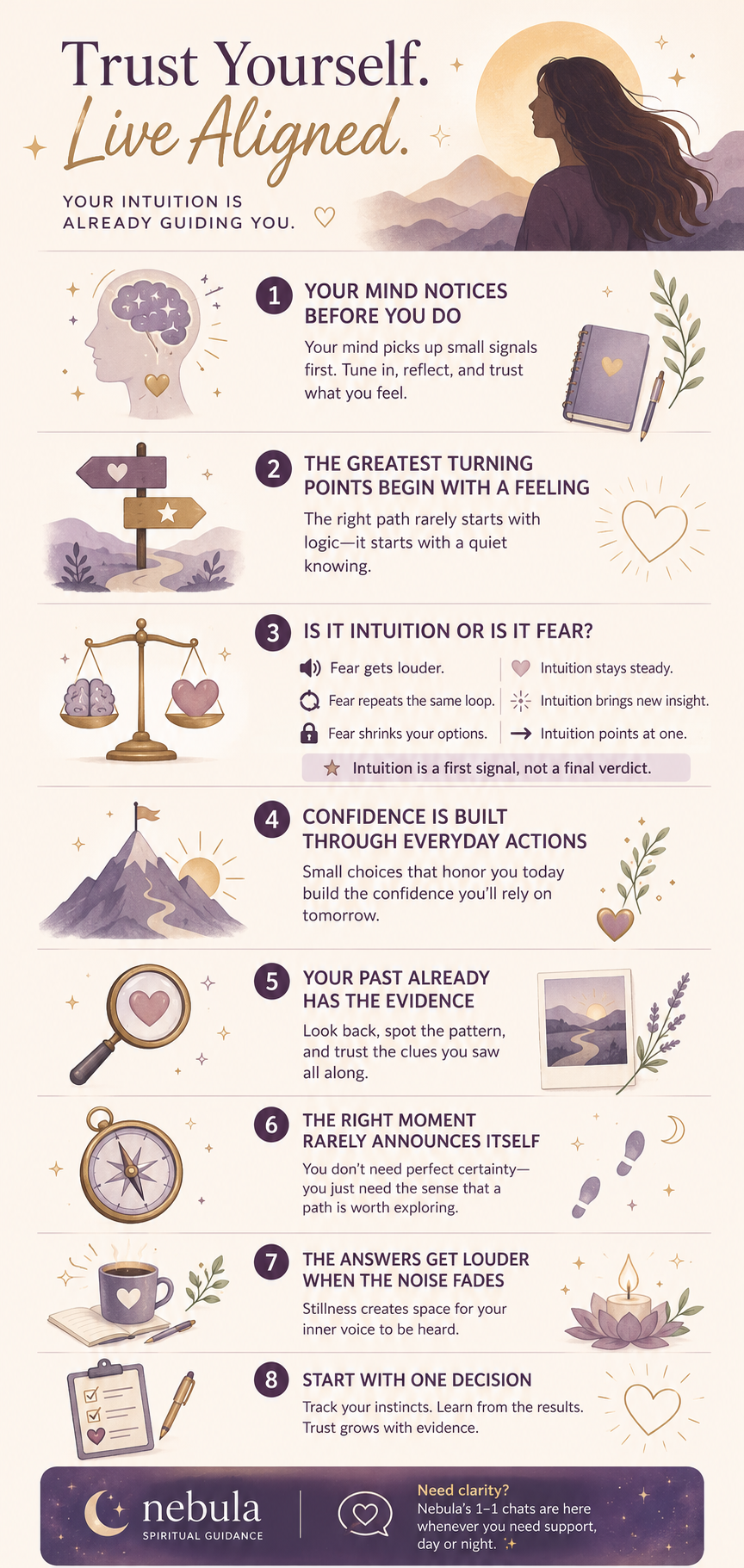
The Greatest Turning Points Begin with a Feeling
Picture an offer that everyone around you envies. The salary is generous. The title looks impressive. Friends tell you you’d be crazy to abandon it.
However, every time you picture yourself there, that nagging feeling appears inside.
After a while, you see the company is struggling, or you realize accepting it would have pulled you away from the work that energizes you.
These moments remind us that intuition often notices things facts haven’t proved yet.
The choices that matter rarely start with, ‘What will amaze other people?’ They start with a far more personal question instead: ‘Does this actually sound like me?’
Is It Intuition or Is It Fear?
Fear is dramatic!!
It demands immediate action and fills your head with worst-case scenarios. Intuition has a different rhythm. Telling the two apart is a skill, and a few patterns make it easier.
- Fear gets louder each time. The thought comes back with a bigger disaster attached, and the volume keeps climbing until you do something about it. Intuition returns at the same level it started, whether you act on it today or next month.
- Fear replays the same loop. The wording barely changes, because fear is protecting you from a scenario it has already decided on. Intuition tends to bring something new each time it surfaces. A detail you hadn’t registered, a question you hadn’t thought to ask, a reason the discomfort makes more sense than it did last week.
- Fear shrinks your options; intuition points at one. When fear is in control, every path looks like a threat, and the only appealing option is to escape. Intuition is more specific. It leans toward a direction and leaves the timing to you.
One thing worth saying plainly: intuition is not always right.
It works best in areas where you have real experience behind you, which makes it a strong first signal rather than a final verdict. Treat it as information worth taking seriously, then check it against what you actually know.
And if a feeling never eases, follows you into every part of your week, and starts affecting how you sleep or work, that’s worth bringing to a doctor or therapist.
No amount of self-reflection is a substitute for that kind of support.
Confidence Is Built Through Everyday Actions
Most people imagine confidence arriving after loud achievements. In fact, real confidence grows much earlier.
It develops each time you politely decline a commitment that leaves you exhausted.
It’s when you launch the project you’ve been postponing or finally name what isn’t working in a relationship that’s been draining you for years. Each decision becomes evidence that you can depend on yourself.
Years later, the moments people tend to remember are the ones where they set a boundary and started trusting their own judgment.
In contrast, they remember the moment they finally set boundaries and started trusting their judgment.

Your Past Already Has the Evidence
Think back to a decision that lingers in your mind. Chances are, it stayed with you because you sensed the outcome.
Maybe you accepted a job that looked like a dream on LinkedIn, only to spend every Sunday dreading Monday morning.
Or maybe you ignored that unsettling feeling about someone since everyone around you insisted they were perfect for you. The clues were there, even if they were easy to miss at the time.
The strange thing about intuition is that it rarely comes with dramatic certainty. In many cases, it’s a lingering discomfort you explain away, or a spark of excitement you convince yourself is unrealistic.
Only later do you realize your inner voice had been trying to protect you or push you toward something better.
Use hindsight to spot the pattern rather than to collect regrets. The more you notice your instincts prove accurate, the easier you can trust them the next time life presents a difficult choice.
The Right Moment Rarely Announces Itself
It’s comforting to believe you’d know what to do when the right timing arrives.
Life is seldom that tidy.
The new city can still feel unfamiliar. The business idea can still carry risk. You can still meet unanswered questions when changing careers.
Waiting for every piece of the puzzle to fall into place turns into another way of standing frozen.
Intuition offers something more useful than a guarantee: the sense that a particular path is worth exploring, even if you can’t see where it leads yet.
Intuition, though, isn’t always right. It’s most useful in areas where you have real experience to draw on, which is why it works better as a first signal than a final verdict!

The Answers Get Louder When the Noise Fades
How often have you looked for an answer and found it the moment you stopped looking? Maybe it turned up on an evening walk, while you were making coffee, or halfway through a long drive with only your thoughts for company.
Intuition tends to work like that. It waits for your attention instead of chasing it, and it surfaces when your mind finally has room to connect ideas that constant scrolling and endless advice keep interrupting.
That’s why stillness matters.
A reflective walk without gadgets, or ten minutes with a notebook, can deliver insights that hours of overthinking never will. Stepping back from everyone else’s opinions is what lets your own voice come through clearly, and many of the decisions that shape a life begin right there.
Start With One Decision
None of this asks you to make a leap this week. It asks you to start collecting evidence.
Pick one decision where your first reaction differed from the answer you eventually talked yourself into. Write both down. Set a reminder for a month from now and see which one holds up.
Do that a few times and something shifts.
You stop asking whether intuition is real and start knowing, from your own record, how reliable yours tends to be and in which parts of your life it earns the most trust. That’s the point where trusting yourself stops being an idea and becomes a habit.
And if you’d like company while you think a decision through, Nebula’s 1–1 chats are there whenever the question comes up, day or night! 🙂
